




In digital advertising, the success of your Google campaign no longer depends only on the size of your budget or the strength of your product. It starts with choosing the right campaign type for your goal. You may have a strong offer, a ready website, and an interested audience, yet the wrong campaign type can deliver results far below expectations.
Google Ads offers several campaign types, and each plays a different role in the customer journey. Search campaigns reach customers at the moment they search, Display campaigns help you build reach and awareness, Shopping campaigns are designed to showcase online store products, and Performance Max campaigns use AI to reach customers across Google’s channels.
In this article, we explain Google Ads campaign types clearly and practically: the difference between Search, Display, Shopping, and Performance Max, when to use each one, their pros and cons, and how to choose the right campaign for your goal, whether you want more sales, more leads, more website traffic, or a stronger brand presence.
What Are Google Ads Campaigns?
Google Ads campaigns are how businesses appear in front of customers across Google’s network, whether they are searching for a product or service, browsing websites, watching videos, or shopping online. Put simply, it is an advertising system that helps you reach the right customer at the right moment with an ad tied to a clear goal, such as more sales, more leads, or more website traffic.
Campaign types vary according to the marketing goal and the customer journey. Some campaigns appear in search results (Search Ads), some help you reach people across websites and apps (Display Ads), some are built to showcase online store products (Shopping Ads), and some are broader AI-driven campaigns such as Performance Max. So Google Ads is not a single fixed tool. It is a complete system with several campaign types, each with a different use and a different result.
The power of Google Ads does not come only from showing an ad. It comes from connecting customer search intent with your business goal. When someone searches for a specific service, compares products before buying, or engages with content related to your field, the right campaign can put your brand in front of them at a key moment in their buying decision. That is why you need to understand campaign types well before launching anything: the right choice improves results, reduces wasted budget, and increases real conversions.
Google Ads Campaign Types
There are several campaign types because no two businesses need the same kind of visibility or the same audience. Some customers search for you directly on Google Search, some need to see your brand several times before deciding, and others compare products and prices before buying. So choosing a campaign type should never be random. It should be tied to your marketing goal, the nature of your product or service, and the customer’s stage in the buying journey.
1. Search Ads
Search campaigns are the best-known and most widely used Google Ads campaign type, because they appear when users are actively searching for a product or service on Google. You are not interrupting the customer with a random ad. You appear when they have a clear need and type keywords related to what you offer, such as “digital marketing agency”, “best dental clinic”, “buy a laptop online”, or “programming course for beginners”.
What Are Search Ads?
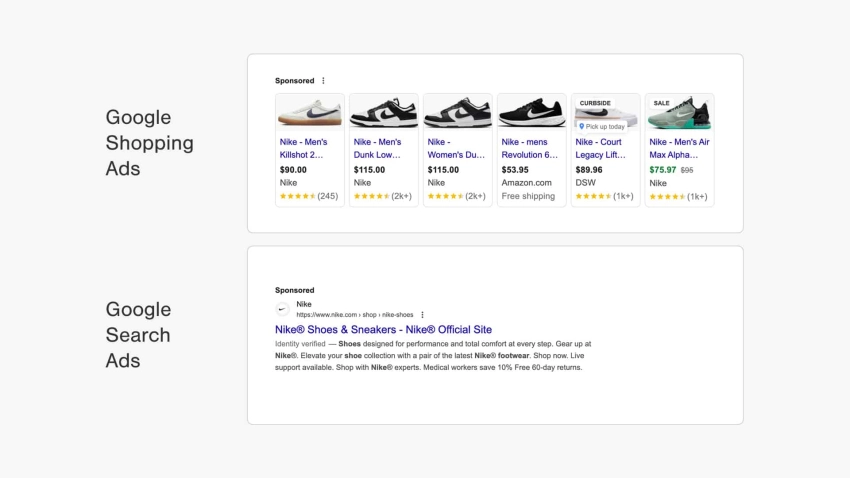
Search Ads are text ads that appear on the search results page when a user types a word or phrase related to your product or service. The ad usually appears above or among the results, with a compelling headline, a short description, and a direct link to a relevant page on your website.
The core idea of this campaign type is search intent: the ad reaches someone who is already looking for a solution, product, service, price, comparison, or provider. That makes Search Ads one of the strongest options for businesses that want to reach an audience ready to act or decide quickly.
Goals of Search Ads
Search campaigns can serve several marketing goals depending on the business and the customer’s stage. The most important are:
- Generating leads: Very effective for collecting customer details through a contact form, phone call, quote request, or consultation booking.
- Driving direct sales: Useful for online stores or product pages targeting users who search for a specific product with clear purchase intent.
- Increasing website traffic: Brings qualified visitors who are searching for a topic or service related to what you offer, as long as you choose the right keywords.
- Capturing high-intent demand: One of the biggest strengths of Search Ads, because they appear at a moment of genuine interest rather than during random browsing.
- Increasing calls and bookings: Ideal for local and service businesses such as clinics, maintenance centers, restaurants, real estate offices, and service companies.
2. Display Ads
Display campaigns are among the most important Google Ads campaign types for putting your business in front of customers while they browse websites, apps, news sites, blogs, and other content platforms across the Google Display Network. Here the ad does not wait for the customer to search for you. It shows your brand to them visually through images, banners, short messages, and eye-catching ad designs.
What Are Display Ads?
Display Ads are visual ads that appear outside the search results page and reach users while they browse content related to their interests, behavior, or the sites they visit. In other words, they help you appear in front of your audience even before they decide to search for your product or service.
These campaigns rely on visual elements such as images, logos, short headlines, and ad messages, which makes them very effective for creating a first impression and building brand awareness. They can also be used to reach new audiences or to retarget previous website visitors through remarketing.
Goals of Display Ads
Display campaigns serve different goals, especially in the early and middle stages of the customer journey. The most important are:
- Building brand awareness: Spreads your business name to a wide audience, especially when you launch a new product or want a stronger market presence.
- Remarketing: Very effective for targeting people who visited your website, viewed your products, or interacted with your pages without completing a purchase or sign-up.
- Increasing engagement with offers and messages: Useful for promoting seasonal offers, discounts, new services, or messages that need repeated visual exposure.
- Supporting sales and conversion campaigns: They are not always as strong as Search Ads for direct conversions, but they support the buying decision by reminding customers of your brand several times.
- Reaching new audiences: Helps you reach segments interested in your field based on interests, behavior, or the topics they browse.
3. Shopping Ads
Shopping campaigns are among the most important Google Ads campaign types for online stores, because they show the product to the customer clearly and directly before they even visit the website. The ad usually shows the product image, price, store name, and sometimes ratings or extra details, so the customer can compare and decide faster than with a text ad.
What Are Shopping Ads?
Shopping Ads are product ads that appear in Google search results or the Shopping tab when a user searches for a specific product. Instead of a plain text ad, the customer sees the product image, price, and store name, which ties the ad closely to purchase intent, especially when the user is comparing products and prices.
These campaigns rely on connecting your store to Google Merchant Center and setting up your product feed correctly. The feed contains key information such as the product name, image, price, availability, category, link, and description. The more accurate and optimized your product data, the better your chances of appearing in front of the right customers.
Goals of Shopping Ads
Shopping campaigns serve clear goals for online stores. The most important are:
- Increasing product sales: Shows your products to people who are already searching for a similar or specific product, which raises the likelihood of purchase.
- Attracting high-quality store traffic: Because customers see the price and image before clicking, the visit is usually more serious than a random visit from someone who knows nothing about the product.
- Improving product visibility on Google: Gives your products strong visual space in search results, especially for keywords with clear purchase intent.
- Winning the comparison: With good images, competitive prices, and clear product titles, Shopping Ads can be a powerful way to attract customers while they compare.
- Supporting e-commerce growth: Suitable for stores that want to scale sales, test different products, or improve the performance of their best-selling categories.
4. Performance Max
Performance Max (PMax) is one of the most advanced Google Ads campaign types, because it uses AI to distribute your ads across Google’s channels from a single campaign. Instead of creating separate campaigns for Search, Display, and video, Performance Max can reach customers across Search, Display, YouTube, Gmail, Maps, and Discover based on the conversion opportunities available.
What Is Performance Max?
Performance Max is an all-in-one campaign built around a clear goal, such as sales or leads, that then uses Google’s automated systems to optimize where your ads appear. The campaign analyzes data, audience signals, and user behavior, then shows your ad on the channel it considers most likely to deliver the result you want.
The core idea is that it does not focus on a single channel. It works as an integrated system that uses several ad placements across Google. That makes PMax a strong option for businesses that want to expand their reach and achieve measurable results, provided the campaign is set up well from the start.
Goals of Performance Max
Performance Max campaigns are built for performance and conversion goals. The most important are:
- Increasing sales: Suitable for online stores that want to reach potential customers across several Google channels and drive real purchases.
- Generating leads: Works for service businesses that rely on forms, calls, quote requests, or consultation bookings.
- Expanding reach across channels: Helps you appear in more places instead of relying on a single channel such as Search or Display.
- Improving performance with AI: Uses machine learning to choose the audience, channel, message, and timing most likely to drive conversions.
- Supporting growth for stores and service businesses: Best for businesses that already have enough data and want to scale after testing other campaigns or building solid conversion tracking.
5. Video Ads
Video campaigns are a good choice for building attention and trust quickly, because they rely on visual content that usually runs on YouTube and on some Google partner sites and apps. That makes them a strong option for businesses that need to explain a product, show an experience, tell their brand story, or deliver a message that a text ad cannot fully explain.
What Are Video Ads?
Video Ads are video ads shown to users while they watch content on YouTube or in other placements within Google’s network. They can appear before, during, or after a video, or within YouTube results and recommendations, depending on the ad format and campaign setup.
The main advantage of this format is the extra room for impact. Instead of relying on a headline and a short description, you can use sound, visuals, motion, scenes, and a problem-and-solution story in one message. That makes Video Ads ideal when you want customers to feel the value of your product or service, not just read about it.
Goals of Video Ads
Video campaigns serve different goals depending on the message and the audience. The most important are:
- Building brand awareness: Introduces your brand to a wide audience in a visual way that is more engaging than a text ad or a static banner.
- Explaining a product or service: Useful if your product needs a demo, a feature walkthrough, or value that an image alone cannot show.
- Building audience trust: Video lets you show real people, experiences, results, or stories that bring your brand closer to customers.
- Supporting product and offer launches: Useful when launching a new product, a new service, a seasonal campaign, or an offer that needs to grab attention fast.
- Remarketing to interested audiences: You can show videos to people who have visited your website or engaged with your content, moving them one step closer to a decision.
6. Demand Gen Campaigns
Demand Gen campaigns are designed to create interest and demand for products and services, instead of waiting for customers to search for them. They help you appear in visual, high-impact placements across Google such as YouTube, Discover, and Gmail, using eye-catching visuals and marketing messages that spark curiosity.
What Are Demand Gen Campaigns?
Demand Gen campaigns aim to attract new audiences or re-engage interested ones through visual ads that appear in browsing and discovery feeds. The customer is not necessarily searching at that moment, but they may be interested in your field or similar to your target audience, so they see an engaging message that encourages them to learn about your product or service.
This campaign type focuses on moving customers from awareness to interest and consideration. It suits businesses that want to build demand around a specific offer, introduce a new product, or widen their audience before the direct purchase stage.
Goals of Demand Gen Campaigns
Demand Gen campaigns are built to capture attention and build desire. The most important goals are:
- Creating demand for a product or service: Introduces your audience to the problem and the solution, even if they are not searching for you directly.
- Increasing awareness and engagement: Suitable for reaching new audiences with strong visual messages that encourage them to engage with your brand or visit your website.
- Moving customers through the funnel: Helps shift audiences from awareness to consideration before targeting them later with stronger conversion campaigns.
- Supporting seasonal campaigns and new offers: Effective when launching an offer, a new product, a new service, or a campaign that needs fast visual reach.
- Re-engaging interested audiences: Can reach people who previously interacted with your brand or showed interest in a similar field.
How to Choose the Right Google Ads Campaign Type for Your Goal
Choosing a campaign type in Google Ads does not start with “Which campaign is best?” It starts with a more important question: “What result do I want?” Each campaign type was built to serve a different goal in the customer journey. A campaign that suits an online store chasing sales may not suit a service company looking for leads, and a brand awareness campaign may not deliver direct sales from day one.
If your goal is to reach customers who are already searching for your service, Search Ads can be a strong choice because they target purchase or direct interest intent. If you want to spread your brand to a wider audience or retarget your website visitors, Display Ads or Video Ads may suit you. And if you run an online store and want to show products with their images and prices, Shopping Ads or Performance Max will usually be the closest match. For a related topic, see our article on SEO vs. Google Ads.
The key is to tie the campaign type to three things: your marketing goal, the nature of your business, and the customer stage you are targeting. Do you want website traffic, sales, lead generation, or a strong brand presence? Once you answer clearly, choosing the campaign type becomes much more precise, and your ad budget turns from spending into a measurable investment you can optimize.
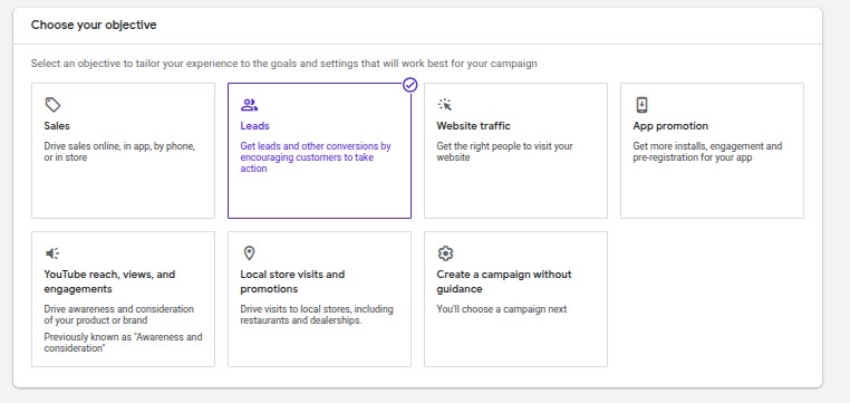
Sales vs. Leads vs. Website Traffic Objectives in Google Ads
When you create a campaign in Google Ads, choosing the marketing objective is not a formality. It sets the direction the platform uses to decide how to show your ad and which audience to reach. So you need to understand the difference between Sales, Leads, and Website Traffic before choosing a campaign type, because each objective serves a different stage of the customer journey and measures a completely different result.
The Sales objective is used when your main focus is direct sales, whether from an online store, a product page, or a service that can be bought online. The campaign focuses on actions such as completing a purchase, adding a product to the cart, or starting checkout, and success is measured with metrics such as sales value, conversion rate, and cost per acquisition (CPA).
The Leads objective fits when the sale does not happen immediately and you first need to collect the potential customer’s details, such as a name, phone number, email, or consultation request. It suits service companies, real estate, clinics, training courses, and B2B companies, because the main result is not a direct purchase but a sales opportunity your team can follow up on later.
The Website Traffic objective focuses on increasing the number of visits to your site, but it does not necessarily mean sales or leads. It is used when you want people to read an article, explore a service, view a specific page, or build early interest in your brand. So if your end goal is sales or sign-ups, do not rely on Website Traffic alone without tracking and optimizing the conversion path, or you will end up with lots of visits but weak business results.
Common Mistakes When Choosing a Google Ads Campaign Type
Choosing the campaign type in Google Ads has a big impact on your results. A mistake here does not just waste budget. It can also make you measure results that have nothing to do with your real goal. Before launching any campaign, remember that each campaign type plays a different role, and success does not come from picking the most popular campaign but the one closest to your business, your customer’s stage, and your marketing goal. The most common mistakes are:
- Choosing the campaign before defining the goal
One of the biggest mistakes is starting a Search, Performance Max, or Display campaign without deciding whether your goal is sales, leads, website traffic, or brand awareness. - Running Performance Max without enough data
Performance Max campaigns are powerful, but they need a good setup, clear conversion tracking, varied ad assets, and suitable landing pages. Running them without a solid foundation can make results unstable. - Relying on Display Ads for direct sales only
Display Ads are excellent for reach and remarketing, but they are not always the best option if your goal is immediate sales from people who are searching for a product or service right now. - Ignoring search intent
In Search campaigns, picking lots of keywords is not enough. What matters is that the keywords reflect clear intent. Someone searching to compare is very different from someone searching to buy or request a service. - Running Shopping Ads without optimizing product data
Shopping campaigns depend heavily on the quality of your product data in Google Merchant Center, such as the title, image, price, description, and category. Weak data reduces your chances of showing and converting. - Not setting up conversion tracking before launch
Launching a campaign without conversion tracking makes performance evaluation inaccurate. You may get lots of clicks without knowing which campaign brought in an order, a call, a sign-up, or a real purchase. - Using the same campaign type for every business
What works for an online store does not necessarily work for a service company, and what works for a well-known product does not work for a new product that needs awareness first. Choose the campaign type based on your business, not on a trend or someone else’s experience.
Tips Before Launching Your First Google Ads Campaign
Launching your first Google Ads campaign needs proper preparation before you spend your budget. Success does not depend only on the campaign type. It also depends on a clear goal, a strong landing page, accurate tracking, and a good understanding of your target audience. Start with a reasonable test budget before scaling, and learn how to set your ad campaign budget in a way that reduces waste and gets the most out of your ad spend. The most important tips before your first campaign:
- Define the campaign goal clearly: Before choosing a campaign type, decide whether you want sales, leads, website traffic, or brand awareness.
- Choose the campaign type based on the goal, not popularity: Do not pick Performance Max or Search Ads because everyone uses them. Pick the type that best fits your business and the customer’s stage in the buying journey.
- Set up conversion tracking before launch: Conversion tracking from day one is essential to know the real action the ad produced, whether a purchase, a sign-up, a call, or a form submission.
- Review your landing page: The ad brings the visitor, but the landing page is what convinces them. Make sure the page is fast, clear, mobile-friendly, and has a direct call to action (CTA).
- Start with a suitable test budget: Do not start with a large budget before you know how your keywords, audiences, ad messages, and offers perform. Testing helps you reduce waste and improve results.
- Write ads tied to the customer’s need: Focus on the benefit and a clear message. You can also improve your results by learning how to write Google Ads copy that raises CTR.
- Monitor key performance metrics: Track CTR, cost per click (CPC), cost per acquisition (CPA), and conversion rate so you can optimize the campaign based on real numbers.
- Do not judge the campaign on day one: Campaigns need enough time to learn and gather data, especially AI-driven types such as Performance Max. Evaluate performance after a reasonable test period, not in the first few hours.
Frequently Asked Questions About Google Ads Campaign Types
Which Google Ads campaign is best for each marketing goal?
The best campaign depends on your goal. For direct sales, Search Ads, Shopping Ads, or Performance Max may suit you. For leads, Search Ads are usually a good starting point. For brand awareness, Display Ads, Video Ads, or Demand Gen are often better.
Which Google Ads campaign is best for increasing sales?
It depends on the type of business. For online stores, Shopping Ads and Performance Max are among the strongest options because they showcase products and target customers across several channels. For services, Search Ads may work better because they appear when the customer is directly searching for the service.
Which Google Ads campaign is best for leads?
Search Ads are among the best campaign types for leads, because they target people who are already looking for a specific service or solution. You can support them with Performance Max or Display remarketing once conversion tracking and a strong landing page are in place.
Which Google Ads campaign is best for website traffic?
If your goal is website traffic, you can use Search Ads to attract high-intent visitors, or Display Ads to reach a wider audience at a relatively lower cost. The choice depends on the quality of traffic you need, not just the number of visits.
Which Google Ads campaign is best for brand awareness?
The best brand awareness campaigns are usually Display Ads, Video Ads, and Demand Gen, because they put you in front of a wide audience with visual messages and engaging content before the customer is ready to search or buy.
Is Performance Max suitable for every business?
Not always. Performance Max is powerful, but it needs good data, a correct setup, varied ad assets, and clear conversion tracking. It may not be the best starting point if you do not have a ready website, enough data, or a defined conversion goal.
Should I start with Search or Performance Max?
If you are starting for the first time and targeting customers who search for your service directly, Search Ads are usually clearer and easier to control. Performance Max is a better fit once you have conversion data, good ad creative, and ready landing pages, and you want to expand across Google’s channels.
What is the difference between Search Ads and Display Ads?
Search Ads appear when users search for words related to your service or product, so they are tied to clear search intent. Display Ads appear as visual ads on websites and apps and are mostly used for brand awareness and remarketing.
What is the difference between Shopping Ads and Performance Max?
Shopping Ads focus on showing products in shopping and search results using your product data in Google Merchant Center. Performance Max is a broader campaign that uses your products and ad assets to appear across multiple channels such as Search, YouTube, Display, Gmail, Discover, and Maps.
Do Display campaigns drive sales?
They can, especially when used for remarketing to people who visited your website or engaged with your products before. But they are usually stronger at building awareness, supporting the decision, and reminding customers of your brand, and they are not always the best choice for direct sales from a cold audience.
What is the most important thing before launching a Google Ads campaign?
Defining the goal precisely and setting up conversion tracking before launch. Without conversion tracking, you will not know whether the campaign produced real sales or leads, or just clicks and visits with no clear results.
Can I run more than one campaign type at the same time?
Yes, and it can be useful if each campaign has a clear role. For example, Search Ads can capture direct demand, Display remarketing can retarget visitors, and Performance Max can help you scale and increase conversion opportunities, as long as budget and measurement are set up correctly.
If you would like a specialist team to handle this for you, explore our Google Ads services.
Sources
- Choose the right campaign type، Google Ads Help
- About Performance Max campaigns، Google Ads Help