





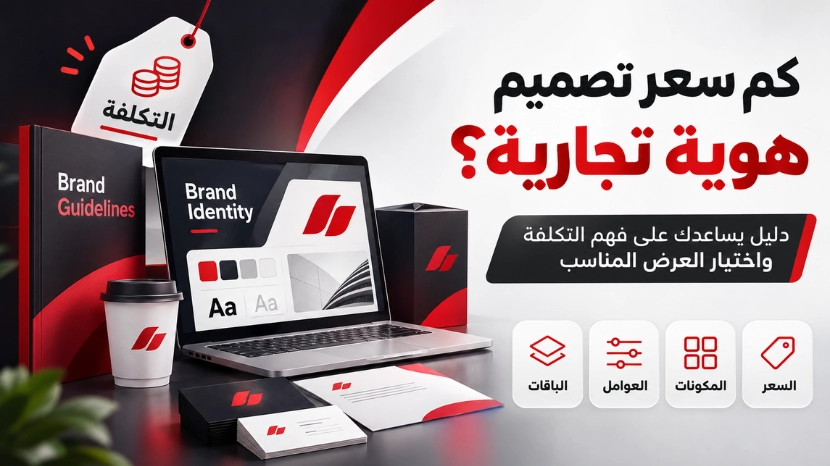
Why might one designer quote you a low price for brand identity design while another quotes much more, even though both offers carry the same service name? Because the cost of a brand identity is not tied to the logo alone. It depends on the scope of work, the deliverables you receive, and the level of research and customization needed before reaching the final design.
A basic offer may include a logo and a color palette only, while another includes a brand strategy, a complete logo system, typography, colors, visual elements, brand applications, brand guidelines, and source files. The two names may sound similar, but the scope is completely different.
So before comparing brand identity design prices between designers or agencies, you need to know what each offer includes, which elements your project really needs, and what can be postponed or developed later. This guide helps you understand the cost and choose the right offer instead of relying on the number alone.
How Much Does Brand Identity Design Cost?
There is no fixed price that works for every brand identity project, because the cost varies with the scope of work, the number of deliverables, and the level of research and customization. A project may be just a logo with basic colors, or it may grow into a complete visual identity with typography, visual elements, applications, and brand guidelines.
So when you look up the cost of a brand identity or visual identity, do not start by asking for a number. Start by defining what you want to receive at the end.
The main factors that affect the price range:
- The size of the identity: Do you need a logo only, or a logo system and a complete visual identity?
- The number of applications: such as business cards, letterheads, social media templates, or packaging.
- The level of strategy: Does the project start with visual execution only, or does it include research, brand direction, and creative direction?
- The number of concepts and revisions: the more design directions and review rounds, the larger the workload.
- Delivery files: Does the offer include source files, brand guidelines, and different file formats?
The key point is that brand identity cost is not calculated by the number of files. It reflects the value of the visual system being built and how well it can serve the brand across different uses.
So the better question is not “How much does it cost?” but “What does this price include?”
What Does the Price of Brand Identity Design Include?
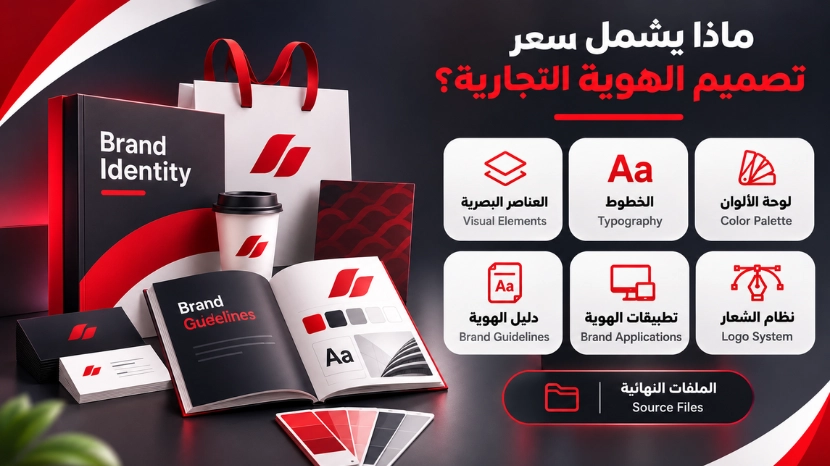
Before deciding which elements belong in your package, it helps to understand the role of each element in the brand’s overall system. The logo, colors, fonts, and supporting elements work together to create a consistent image for your audience. You can learn more about what visual identity is and its elements to define more precisely what your project needs and what to include in your identity package.
When you order a brand identity, you are not paying for a logo and a few files. You are paying for a visual system that helps your brand appear consistently on your website, social media, print, packaging, and other touchpoints. That is why two packages can carry the same name while their value differs depending on the elements and deliverables they include.
Key elements that may be included in brand identity design packages:
- Logo system:
More than a single logo. It may include the primary logo, a secondary version, a brand mark or icon, and horizontal, vertical, and single-color versions for different backgrounds. These versions make the logo more flexible across different spaces and applications. - Color palette:
Defines the brand’s primary and secondary colors and their codes for digital and print, which keeps the look consistent instead of choosing new colors with every design. - Typography:
Specifies the fonts for headings and body text and how to combine them. If the brand works in both Arabic and English, it is important to choose fonts that match visually across both languages. - Supporting visual elements:
May include patterns, icons, graphic elements, and a photography or illustration style. These elements give the brand its own character and help people recognize it even when the logo is not the main element. - Brand applications:
Examples that show how the identity works in real use, such as business cards, letterheads, email signatures, social media templates, packaging, or presentation templates. The applications needed vary by business. - Brand guidelines:
Rules for using the logo, colors, fonts, and spacing, with examples of correct and incorrect use, so any designer or marketing team can apply the identity later without the brand changing from one channel to another. - Final files and source files:
Check which files you will receive, and whether they include print and digital versions plus editable source files, or only final files.
When comparing brand identity design prices, do not just count files. Ask: Which elements will I actually use? Does the package give me a visual system I can apply consistently, or just a set of separate designs? The clearer the deliverables from the start, the more accurate your comparison will be.
Color Palette
Colors are not just an aesthetic choice. They are among the elements that most help people recognize and remember a brand. A color palette defines the main colors that represent the identity and the secondary or supporting colors that can be used when needed without breaking visual consistency.
A color palette may include:
- Primary colors: the main colors associated with the brand.
- Secondary colors: supporting colors that expand design options.
- Accent colors: colors used to highlight elements such as buttons, offers, or key information.
- Color codes: codes for digital and print use so colors look as close as possible across different media.
A clear color palette makes the identity easier to apply on your website, social media, print, and packaging, and prevents random shades that gradually erode brand consistency.
Typography
Fonts directly affect the brand’s personality and how its messages are read. Choosing typography is not about finding a pretty font. It must suit the business, stay clear across different uses, and fit with the rest of the identity.
A type system may define:
- Heading font: to highlight key messages and give the identity a clear character.
- Body font: for comfortable reading in long content, print, and on the website.
- Arabic and English fonts: chosen to work together visually when both languages are used.
- Weights and sizes: to distinguish main headings, subheadings, body text, and details.
Typography matters even more for brands that work in Arabic and English, because two mismatched fonts can make the identity feel like two separate systems. Color and type must work together to build a unified visual style that can be repeated consistently across every touchpoint.
Visual Elements
A strong identity does not rely on the logo alone. The brand needs supporting elements that keep a consistent visual style across different uses. These elements give designs a coherent character and help people connect content to the brand even when the logo is not the most prominent element.
Visual elements may include:
- Patterns: repeating motifs used in backgrounds, print, and packaging.
- Icons: a consistent icon set that reflects the brand’s style.
- Graphic elements: supporting shapes and graphics used in ads, posts, and other designs.
- Shapes: defined visual shapes that help unify layouts.
- Photography style: rules for choosing images in terms of lighting, color, and composition.
- Illustration style: a unified illustration style if the brand uses illustrations.
These elements help build a visual language that can be used repeatedly, instead of relying on the logo alone in every design.
Brand Applications
Brand applications show how the visual system moves from rules on paper to real-world use. They are not separate from the identity. They are practical examples of how colors, fonts, the logo, and visual elements work together at different touchpoints.
Depending on the business, applications may include:
- Business cards and letterheads for stationery.
- Email signatures for official correspondence.
- Social media templates for digital content.
- Packaging if the business sells products.
- Presentation templates for pitches and meetings.
- Signage for branches or retail spaces.
- Uniforms if a team deals directly with customers.
- Bags or labels for stores and products.
More applications do not automatically make a package better. What matters is choosing the applications the business will actually use. An online store may need packaging and social media templates more than a letterhead, while a service company may need presentations and email signatures more.
The number and type of brand applications directly affect the project scope, so it is best to define them based on the brand’s real touchpoints rather than adding them just to make the package look bigger.
If social media is one of your main channels, distinguish between designing identity templates for social media and producing new ad creatives on an ongoing basis. The first can be part of brand applications, while the second is a separate design service with its own scope and cost. See our guide to social media ad design costs to understand the difference between the cost of building core templates and the cost of ongoing ad content.
Brand Guidelines
Brand guidelines are the reference that explains how every element of the brand identity should be used correctly and consistently. Their value shows after the design stage, when marketing teams, designers, or suppliers start applying the identity across channels and print.
Guidelines may include:
- Logo usage rules: when and where to use each version of the logo.
- Clear space: to keep the logo clear and uncluttered by surrounding elements.
- Minimum size: to keep the logo legible in different uses.
- Color palette: approved colors and their codes.
- Typography: fonts, weights, and sizes for headings and body text.
- Incorrect uses: examples of what to avoid when applying the identity.
- Imagery and visual element style: to keep content consistent with the brand’s personality.
- Application examples: how the identity looks across different media.
Brand guidelines become more important as more people or partners work with the brand, because they reduce individual interpretation and keep the identity consistent instead of changing from one design to the next.
Final Files and Source Files
After the identity is approved, do not focus only on how the designs look. Pay attention to the files you will receive and how you will use them later. Some formats suit print, others suit websites or social media, and you may need the original files if you want to edit or develop the identity in the future.
Common formats include:
- AI and EPS: editable files suited to design and print work.
- SVG: suited to digital use while keeping the logo sharp at any size.
- PDF: useful for sharing, printing, and presenting identity elements.
- PNG: suited to digital use, especially when you need a transparent background.
Not every package has to include every format, so before you agree, confirm which source files and final files will be delivered and whether they are editable or for final use only.
In the end, do not judge a complete brand identity by the number of files in the package, but by the value of the deliverables and how much you can actually use them after the project ends. A good identity does not end at delivery. It should give you a clear system and the right files to keep applying it without losing brand consistency.
What Factors Determine the Cost of Brand Identity Design?
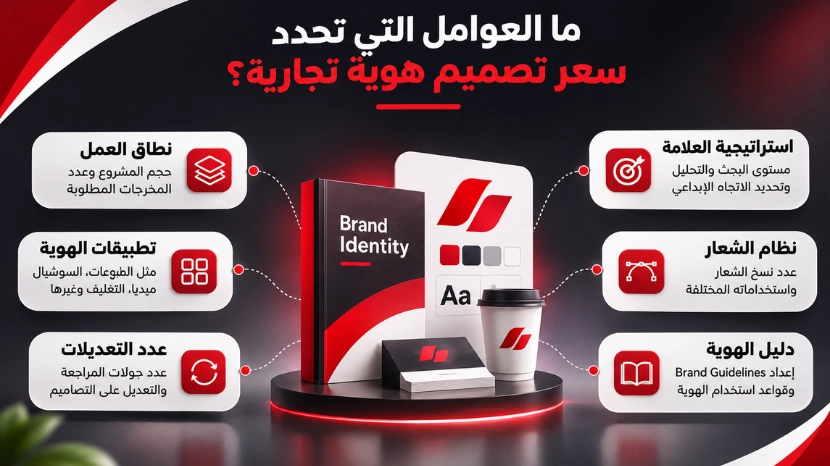
Two identities may look similar at first glance at the logo or colors, but the research, thinking, and execution behind each project can be completely different. That is why brand identity design prices depend on several factors beyond the final look.
- Project size and type of business:
An identity for a small local business differs from a brand with several products, branches, or markets, because there are more touchpoints, a different audience, and more application requirements. - Level of research and strategy:
Executing a logo from a ready brief is very different from a project that starts with research, competitor analysis, positioning, and creative direction, then builds a visual identity on those findings. - Number of concepts:
If several complete visual directions must be developed before choosing one, each direction needs time for research, design, and presentation, which expands the scope. - Number of brand applications:
Every additional application needs design, review, and adaptation, whether packaging, stationery, social media templates, or presentations. - Arabic and English:
A bilingual identity may need different typography work, attention to writing direction, and balance between Arabic and English words in applications. - Number of revisions:
Changing a color or detail within an approved concept is different from asking for a completely new direction after the design stage. Revision rounds should be defined clearly. - The provider’s experience:
A freelancer, design studio, or branding agency may each offer a different level of research, strategy, and project management. Higher prices are not always better, so compare the level of service with what you actually need. - Timeline:
Urgent projects may require extra resources or a reshuffled schedule, so they may cost more than a project with a comfortable timeline.
So the cost of visual identity design can only be judged fairly once you know the full scope, the number of deliverables, the process, and the time needed to complete the project.
Basic or Complete Identity: Which Package Fits Your Project?
Choosing between a basic identity and a complete identity does not depend on price alone. It depends on the stage of your project and how many touchpoints the brand will appear on.
When is a basic identity enough?
A basic identity may be suitable if the project is just starting and does not need many applications.
It can suit:
- A project in its testing stage.
- A small business with a limited number of channels.
- A project that needs only a logo, colors, and fonts.
- A brand starting digitally without packaging, branches, or many applications.
In this case, you can build a solid visual foundation and develop applications later as the project grows.
When do you need a complete identity?
A complete brand identity makes more sense if the brand will appear across many touchpoints, such as:
- An online store.
- A company working across several channels.
- A brand with packaging.
- A company with a marketing team.
- A business that runs campaigns constantly.
- A project targeting more than one market or language.
- A brand that works with several suppliers and designers.
The benefit is not getting more files. It is having a clear system that stops each team or designer from interpreting the brand differently.
The practical rule: Decide where your brand will appear over the next year, then choose the package that covers those uses without adding elements you will not need.
A complete identity matters even more when the brand relies on ad campaigns, because ads must keep the same colors, fonts, and visual style even as offers and messages change.
If Facebook is one of your main channels, understanding how to set up Facebook ads helps you see how the identity moves from brand guidelines into real creatives used in campaigns.
Logo Design vs. Complete Brand Identity: What Is the Difference?
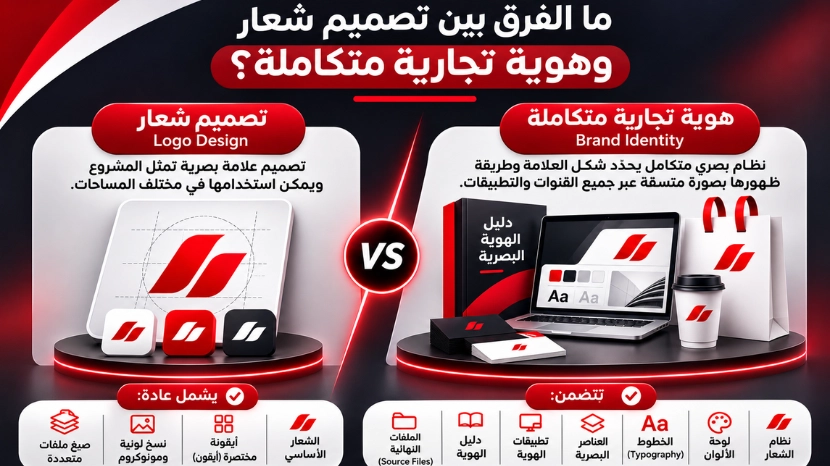
The logo is a core part of the identity, but it is not the whole identity. Logo design focuses on creating a recognizable visual mark, while complete brand identity design builds a full visual system that defines how the brand appears on the website, social media, print, packaging, and other touchpoints.
So the real difference is not the number of files, but the size of the system built around the brand and how it is used after delivery.
Logo Design
Logo design focuses on creating a symbol or wordmark that represents the business and can be used in different spaces and sizes. Depending on the agreed scope, the service may include:
- Primary logo: the main version of the logo.
- Secondary logo: an alternative version for different spaces.
- Brand mark or icon: a compact symbol for small applications or profile pictures.
- Color and single-color versions: for different backgrounds.
- Multiple file formats: for print and digital use.
This service gives you a clear mark that represents the business, but it does not necessarily define how colors, fonts, images, social media posts, or packaging should look when used together.
Complete Brand Identity
When you order a logo and complete visual identity, the logo becomes part of a larger system that defines the brand’s overall look and how to apply it consistently.
The identity may include:
- Logo system: logo versions and usage rules.
- Color palette: primary and supporting colors.
- Typography: fonts and how to use them.
- Graphic elements: patterns, shapes, and visual elements.
- Photography or illustration style: the style of images or illustrations.
- Brand applications: applications such as social media, packaging, and print.
- Brand guidelines: a guide that explains how to use all these elements.
The goal of this system is to make different touchpoints feel like part of the same brand, even when the platform or content type changes.
For example, if a customer sees an ad, a product package, or a post without a clearly visible logo, they may still recognize the brand from its colors, fonts, and recurring visual style.
That is why the cost of logo design alone differs from the cost of a complete brand identity. The first focuses on building the core mark, while the second builds a visual system that can be used and developed across many channels and applications.
How to Choose the Best Brand Identity Design Quote
The lowest price is not necessarily the best value, and the highest price does not automatically guarantee the best result. A fair comparison starts with the scope, experience, process, and deliverables you will use after delivery.
- Compare scope, not just price:
Do not compare a logo-only offer with one that includes a logo system, applications, and brand guidelines. The services should be similar before you compare prices. - Review the portfolio carefully:
Do not just look for attractive designs. Check whether the provider can deliver different styles for each brand, or repeats the same style in every project. - Check for brand guidelines:
If the brand will be used by a team or several suppliers, clear usage guidelines help maintain consistency. - Ask about source files:
Find out which files you will receive and which formats you will need for print and digital use. - Check the number of concepts and revisions:
Confirm how many directions will be presented and how many revision rounds are included. - Check the timeline:
There should be clear stages for research, design, review, and approval, not just a vague deadline. - Review usage rights:
Make sure the rights to use the final identity after payment and delivery are clear. - Assess how well they understand your business:
A good brand identity design company does not just ask about your favorite color. It tries to understand your audience, market, business, and where the brand will be used.
The best quote strikes a sensible balance between needs, deliverables, quality, process, and budget.
How to Reduce Brand Identity Costs Without Sacrificing Quality
You can reduce the project cost without settling for a weak solution if you set the scope correctly from the start.
- Define your needs precisely: ask for the elements you will actually use instead of adding unnecessary applications.
- Prepare a clear brand brief: clarity about the audience, product, and goal reduces time wasted on unsuitable directions.
- Define the decision makers: many conflicting opinions increase revisions and delay the project.
- Consolidate your feedback: give organized feedback in one round instead of sending scattered edits.
- Start with a scalable foundation: if your budget is limited, start with a logo system, colors, and typography, then add applications as the business grows.
- Do not change direction after approval: changing the creative direction completely at an advanced stage may add new work to the project.
Real savings come from cutting unnecessary work, not from removing the core elements the project needs.
Common Mistakes When Ordering a Brand Identity
Clients sometimes raise the cost or get a weaker result because of how the project is managed, not because of the designer.
- Confusing a logo with a complete identity: leads to expecting deliverables that were not in the offer.
- Choosing the lowest price only: an offer may be cheaper because it has a smaller scope, not because it delivers the same service for less.
- Asking for too many concepts: more directions are not always better and can make choosing harder without real benefit.
- Not defining future uses: you may end up with a beautiful identity that does not work for packaging, social media, or digital use.
- Ignoring Arabic and English: if the brand will work in both languages, typography and application must be considered from the start.
- Not asking about source files: you may need them later when working with other designers or printers.
- Skipping brand guidelines: leads to the brand looking different from one channel to another.
- Changing direction after execution starts: adds time and cost and may send the project back to an early stage.
- Copying a competitor: may produce an identity that is not distinctive or that looks too close to another brand.
- Focusing on looks only: an identity must be usable and scalable, not just a beautiful presentation.
In short, you cannot judge the price of a brand identity by the number alone. The cost is tied to the project scope, deliverables, level of strategy, number of applications and revisions, brand guidelines, and the provider’s experience.
First decide where your brand will be used and which elements you really need, then compare offers with a similar scope. That way you can choose the identity that delivers the best value for your project, rather than the lowest price or the most files.
Frequently Asked Questions About Brand Identity Design Costs
How much does brand identity design cost?
There is no fixed price for every project. The cost varies with the scope, the number of deliverables, the level of research and strategy, the number of applications and revisions, and the provider’s experience.
Why do brand identity design prices vary so much?
Because each offer may include a different scope. One may include a logo and colors only, while another includes a complete visual system with applications, brand guidelines, and source files.
Does logo design include visual identity?
Not necessarily. The logo is one element of the identity, while visual identity includes a broader system of colors, fonts, elements, and applications.
What does a complete brand identity include?
Depending on the project scope, it may include a logo system, color palette, typography, visual elements, brand applications, brand guidelines, and source files.
What is the difference between a basic and a complete identity?
A basic identity focuses on the essentials needed to start, while a complete identity includes a broader visual system, applications, and usage rules for brands that work across many channels.
Are brand guidelines necessary?
They become especially important when the brand works with a marketing team, designers, or several suppliers, because they define how the identity is used and keep it consistent.
Does an identity package include social media designs?
It depends on the scope. Some packages include social media templates, while others treat them as an additional application.
Should source files be part of the delivery?
It is best to confirm this before agreeing. If you will need to use the identity later with other teams or suppliers, the original files are important.
How long does brand identity design take?
It depends on the project size, the number of stages, concepts, revisions, and applications. Agree on a clear timeline instead of relying on a general duration for every project.
How do I choose a brand identity design company?
Compare portfolios, how well they understand your business, scope, deliverables, revisions, and timeline, not just price.
Can I start with a simple identity and develop it later?
Yes, if the foundation is built correctly and is scalable. You can start with a logo system, colors, and fonts, then add applications and brand guidelines as the project grows.
Sources
- What is branding? How to build a brand people love، HubSpot Blog
- Visual identity design، HubSpot Blog